Training on the Application of the Monitoring Methodologies
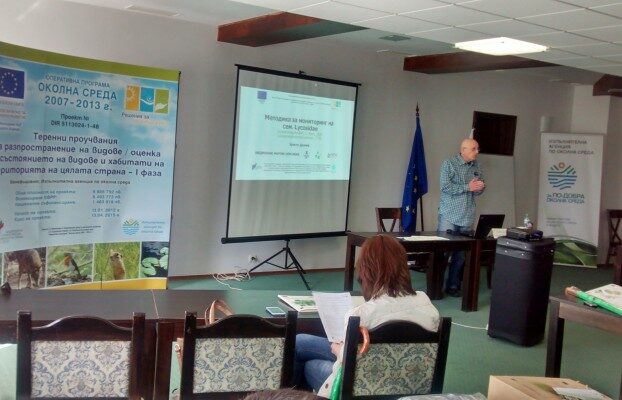
Within the framework of projects for field surveys of the distribution and abundance of invertebrates, fish, amphibians and reptiles, a training course was held on 21–23.05.2014 to familiarise experts from the Executive Environment Agency (ExEA), the Regional Inspectorates of Environment and Water (RIEW), and the national and nature park directorates with the methodologies for monitoring the target species of the three animal groups. The theoretical part of the training included a presentation of three of the invertebrate monitoring methodologies (for spider species of the family Lycosidae, for crustacean species of the class Crustacea, and for beetle species of the family Carabidae). The lecturers were the experts who developed the methodologies: Hristo Delchev (Leader of the “Invertebrates” group), Milcho Todorov and Evgeni Chehlarov, respectively. In the practical part, the application of the three methodologies in the field was demonstrated. Individual approaches of the fish monitoring methodology were explained theoretically, followed by a practical demonstration of the approach for monitoring fish in rivers. The training was delivered by key experts involved in developing the methodology – Lachezar Pehlivanov and Milena Pavlova. The leader of the “Amphibians and Reptiles” group, Nikolay Tsankov, introduced participants to the specifics of the amphibian and reptile monitoring methodology for each individual species subject to monitoring. The field activities involved in applying the methodology were then demonstrated. For all methodologies, the species composition and the particulars of carrying out monitoring were explained in detail: preliminary preparation, team, required technical equipment, field observation, and frequency of observation. The completion of the general and specific sections of the field forms for each of the methodologies discussed was also explained. Participants were introduced to the general safety rules for fieldwork: appropriate personal equipment; conduct in the field; team and team interactions; setting and observing check-in times; necessary first-aid supplies; and response and first aid in case of injury, bites from venomous animals or illness. After the training, a survey was conducted among participants to obtain feedback on their satisfaction with its content and organisation. The results showed a positive assessment of the theoretical information presented and of the practical demonstration of the monitoring methodologies. This document was produced within the project “Field surveys of species distribution/assessment of the conservation status of species and habitats across the whole country – Phase I”, under Order RD-23/13.01.2012 of the Minister of Environment and Water for the provision of grant funding, co-financed by the European Union through the European Regional Development Fund. The consortium “Fortis-NPM-IBEI” bears full responsibility for the content of this publication, and under no circumstances can this document be regarded as reflecting the official position of the European Union or of the Government of the Republic of Bulgaria, represented by the Ministry of Environment and Water.